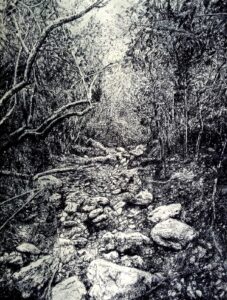
In the arid woods / copperplate by Bert Kienjet
Jason Arday’s reportedly self-inflicted death has been widely attributed to a dual pressure: a relentless flood of general media attention, and a distinctly hostile, racially charged undercurrent of criticism. Neither narrative is easily defended. For years, Arday successfully navigated an academic landscape that frequently thrust him into the global spotlight. He actively sought this attention, given the publication of his autobiography. By his own account, he had spent a lifetime navigating the realities of systemic discrimination, understanding intimately how to confront it—insights that naturally formed the core of his academic work. Arday had always stood his ground. Yet, ultimately, even this fiercely resilient man broke, proving that he was, above all, a human being of flesh and blood.
By Aart G. Broek; originally on the website New English Review / the Iconoclast, August 23, 2026
Words matter. Words have the power to humiliate and evoke shame, but silence can be at least as humiliating and have a similarly shameful effect. This paradox is less contradictory than it seems at first glance, a truth aptly captured in a famous quote: “In the end, we will remember not the words of our enemies, but the silence of our friends.”
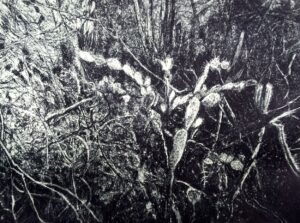
copperplate by Bert Kienjet
The Anatomy of Institutional Silence Whether or not this quote is accurately attributed to Dr. Martin Luther King Jr., it underscores a profound indifference that humiliates those in desperate need of solidarity. This callous silence cuts deep because it is experienced as betrayal—a breach of trust that violates the fundamental loyalty expected from personal, academic, and institutional allies.
Arday resigned of his own accord. He stepped down as a professor at the University of Cambridge under pressure from disciplinary proceedings due to allegations of plagiarism and inaccuracies regarding his conduct and past. While framed as voluntary, ‘resignations’ from high-ranking positions are frequently the product of intense institutional duress. In Arday’s case, this pressure materialized through Cambridge University’s announcement of a formal inquiry into his academic qualifications. Equally significant was the immediate alienation from his own college; by launching its own parallel investigation, Jesus College effectively severed his remaining ties, stripping away the institutional foundation required to maintain his post.
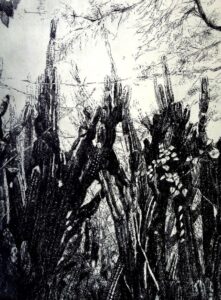
In the arid woods / copperplate by Bert Kienjet
The Neurobiology of Exclusion / When the University of Cambridge and Jesus College distanced themselves from Arday by initiating formal investigations, his undoubtedly hard-won refuge—and the accompanying sense of security—was shattered. For an individual whose identity was so inextricably linked to institutional acceptance, appreciation, and safety, the sudden withdrawal of professional support was far more than a career setback; it was an existential earthquake. Neuroscientific research by Naomi Eisenberger demonstrates just how profoundly such a rupture wreaks havoc on the human nervous system—a reaction rooted in evolutionary necessity, given that social exclusion historically equated to a death sentence.
Arday was no stranger to intense media scrutiny, criticism, and racism, yet he had previously navigated these challenges from the emotional sanctuary of a robust professional network that had supported and defended him generously. When this very socio-emotional structure collapsed, it left behind an acutely painful and ultimately unbearable void. The seismic shift from a supportive community to absolute isolation inflicts severe trauma, a phenomenon extensively documented in the landmark research on ostracism by Kipling Williams and his colleagues. Ultimately, the devastating impact of public humiliation—and the paralyzing fear of further shame—transcends ethnicity, gender, or social class. It is, fundamentally, a universal human tragedy.
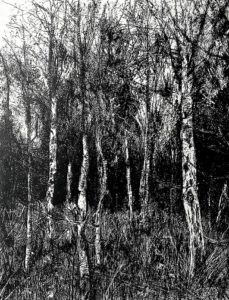
Down the Heartland / copperplate by Bert Kienjet
Sounding the Alarm on Ideological Frenzy / Extensive sociological and psychological research into public humiliation supports this reasoning. When public figures fall, the primary driver of suicidal ideation and action is rarely the ridicule itself, but rather the sudden, absolute ‘social death’ that accompanies it. When colleagues fall silent, when institutions issue sterile, bureaucratic statements, and an individual is effectively ostracized from a defining community, the isolation becomes total. The very world in which Arday had built his life—and envisioned his future—collapsed.
Is this narrative accurate? I do not know. Yet it is no more speculative than attributing his death to institutional discrimination, overwhelming media scrutiny, disproportionate backlash over plagiarism, or the alleged glorification of mediocrity via DEI policies. If the impact of exclusion is indeed as devastating as research suggests, then discrimination, media scrutiny, demonization, and ideological glorification all play a role. Consequently, the critical scrutiny applied to Arday’s publications by Emeritus Professor David Harris and philosopher Nathan Cofnas—whether intentional or not—would undeniably have carried severe weight.
By outlining this plausible trajectory, I am sounding an alarm against the absurdity of the absolute certainty currently being expressed en masse, despite the scant factual data available. From death threats against Cofnas and pleas to suppress media scrutiny of scientists of color, to legislative pushes for expanded DEI policies, the dismissal of white academics from Arday’s former department, and the outright canonization of Arday himself—nothing about this public frenzy offers a constructive contribution to anyone’s emancipation.
***
The enclosed copperplates are by the Dutch visual artist Bert Kienjet, inspired by his regular visits to the Dutch Caribbean island of Curaçao, which cherishes a relatively arid landscape.